Cats are not small dogs, and their diet is one of the areas where that matters most. As obligate carnivores, cats have specific nutritional needs that only a complete cat food reliably meets, and some everyday foods that are fine for us, or even for dogs, are genuinely dangerous to them. Sharing a little food with a cat is not the ritual it is with a begging dog, cats are fussier and less food-driven, but it still pays to know clearly what is safe and what is not, because a few common foods can do real harm.
The usual honest note first: I am a writer, not a vet, individual cats vary, and if your cat eats something dangerous the right move is always to call your vet rather than to look it up and wait.
The genuinely dangerous foods
Some human foods are actively toxic to cats, and these are the ones every cat owner should know by heart.
Chocolate is toxic to cats as it is to dogs, because of theobromine, though cats are far less likely to eat it since they cannot taste sweetness. Onions and garlic, and the whole allium family including leeks and chives, damage cats’ red blood cells and cause anaemia, and cats are more sensitive to them than dogs, so even small amounts, including the onion and garlic cooked into human food or found in some baby foods, are a real hazard. Grapes and raisins can cause kidney problems. Alcohol and caffeine are both toxic. Raw yeast dough is dangerous for the same reasons it is in dogs, rising and fermenting in the stomach. These are not merely unhealthy foods, they can cause serious harm, so they belong well out of a cat’s reach.
Where cats differ from dogs
Beyond the shared toxins, there are a couple of cat-specific points that catch people out, because they run against common assumptions.
The first is dog food. It is not poisonous, and a cat stealing the odd mouthful of the dog’s dinner is not an emergency, but dog food is not a substitute for cat food. Cats need certain nutrients that dogs do not, above all taurine, an amino acid cats cannot make enough of themselves, along with more protein, vitamin A, and arachidonic acid, and dog food does not provide these in the amounts a cat requires. A cat fed dog food over time can develop serious deficiencies, including taurine deficiency that damages the heart and eyes. So cats must eat food made for cats. The second is milk. Despite the saucer-of-milk image, most adult cats are lactose intolerant and cannot digest milk well, so it tends to cause stomach upset rather than being the treat we imagine. Fresh water is what a cat actually needs.
What is fine in moderation
None of this means you can never share anything, and a few plain foods are safe as occasional treats, though the bar is different for cats.
In small amounts, plain cooked meat or fish with no seasoning, bones, or skin, and a little plain cooked egg, are generally fine as the occasional treat, and many cats enjoy a scrap of plain chicken or a flake of cooked fish. The key word, as with dogs, is plain: it is the seasoning, onion, garlic, salt, and sauces we add that turn a safe food risky. But cats are obligate carnivores whose needs are met by a complete, balanced cat food, so human food should only ever be a tiny extra, not a real part of the diet, and treats of any kind should stay well within a small fraction of what the cat eats. Fish in particular, including tuna, is a treat rather than a staple, since a fish-only diet lacks things a cat needs and can cause problems.
Quick answers: can cats eat…?
Feeding questions go beyond individual foods, too. If you are weighing up how to feed day to day, see our honest guide to wet vs dry cat food, where the moisture point matters more than most people realise.
For the questions people ask most, we have a straight answer on each, with how much is safe and what to do if your cat has had some:
- Can cats eat chocolate? (no, toxic)
- Can cats eat onions and garlic? (no, toxic)
- Can cats drink milk? (usually not, most cats cannot digest it)
- Can cats eat dog food? (not as a diet)
- Can cats eat tuna? (an occasional treat only)
- Can cats eat eggs? (yes, cooked, in moderation)
- Can cats eat chicken? (yes, plain cooked, an excellent treat)
- Can cats eat salmon? (yes, cooked, an occasional treat)
- Can cats eat cheese? (a poor treat, better skipped)
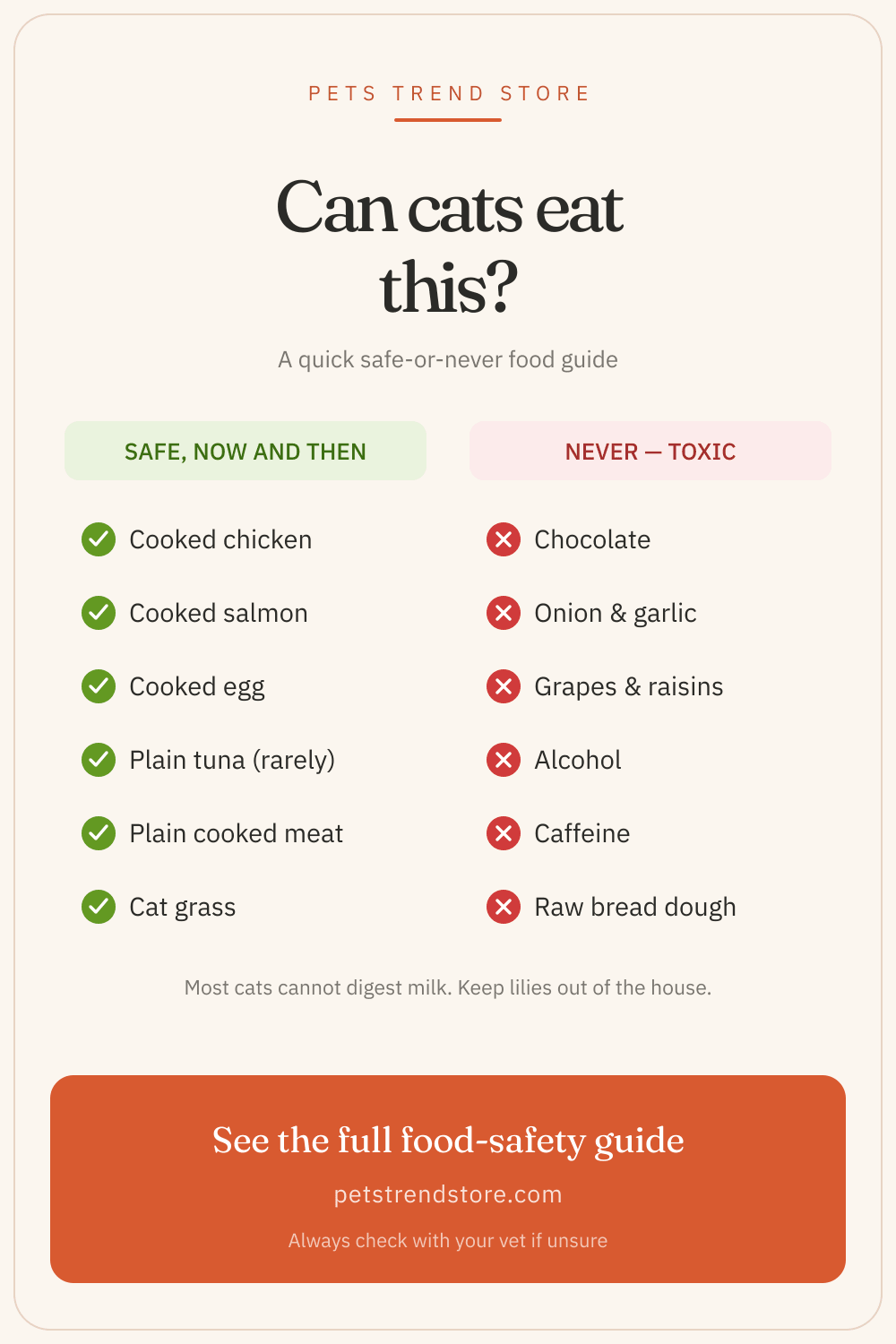
Kept in mind, feeding cats safely is simple enough. Learn the dangerous list, chocolate, onions and garlic, grapes and raisins, alcohol, caffeine, raw dough, and keep lilies out of the house entirely. Feed a complete cat food as the diet, not dog food, skip the milk in favour of water, and share only tiny amounts of plain cooked meat, fish, or egg as occasional treats. Do that and you cover the essentials, and keep your vet’s number, and a pet poison line, findable, because the time you need them is the time you will not want to be searching.
Common questions
- What human foods are toxic to cats?
- The most important dangerous ones are chocolate, onions and garlic (and the whole allium family), grapes and raisins, alcohol, caffeine, and raw yeast dough. Cats are especially sensitive to onions and garlic. Many cats are also unable to digest milk. Keep all of these away from your cat.
- Can cats eat dog food?
- Not as a diet. A stolen mouthful now and then will not poison a cat, but dog food lacks nutrients cats specifically need, above all taurine, and a cat fed dog food long term can develop serious deficiencies affecting its heart and eyes. Cats must eat food formulated for cats.
- What human foods can cats eat safely?
- In small amounts, plain cooked meat or fish with no seasoning, bones, or skin, and a little cooked egg, are generally fine as occasional treats. But cats are obligate carnivores with specific needs met by a complete cat food, so human food should only ever be a tiny extra, not a meaningful part of the diet.