A dog that panics when it is left alone is one of the most distressing problems an owner can face, partly because it is so easy to misread. The chewed door frame and the neighbour’s complaint about howling look like a badly behaved dog, so the instinct is to tell the dog off. But separation anxiety is not naughtiness, it is genuine fear, closer to a panic attack than a tantrum, and telling a frightened dog off only deepens the fear. Once you see it for what it is, the path forward is clear and, with patience, very effective. Here is how to recognise separation anxiety and help your dog learn that being alone is safe.
What it looks like, and what it is not
The defining feature of separation anxiety is that the distress is tied to being alone, so the first job is to work out whether that is really what you are dealing with.
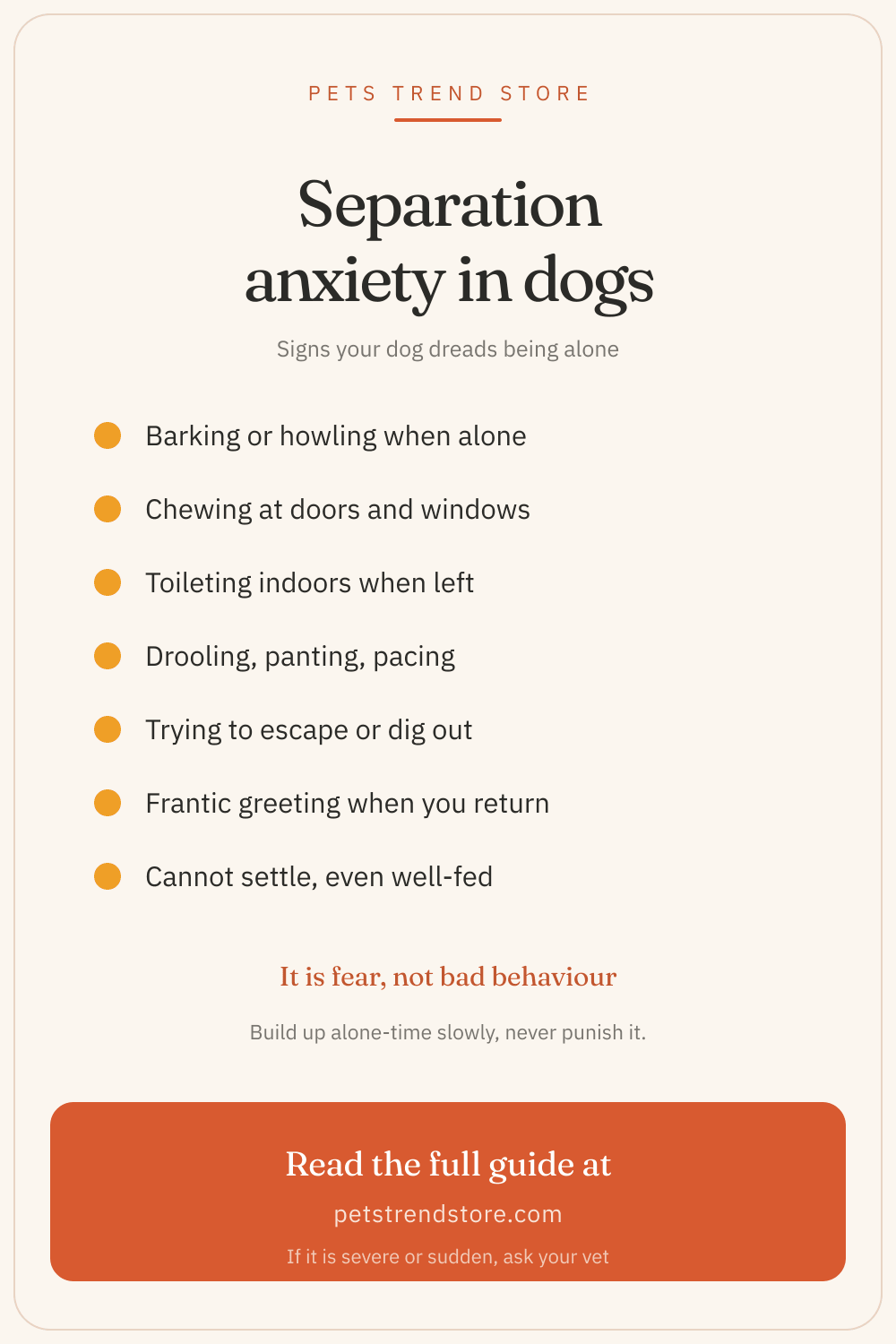
Signs that appear only when your dog is left, and typically within the first several minutes, point to anxiety: barking, howling, or whining that starts soon after you leave, destruction aimed at exit points like doors and windows rather than random chewing, indoor toileting from a normally clean dog, drooling, pacing, and a frantic, over-the-top greeting when you get home. The single most useful thing you can do is film or watch the first half hour after you leave, because it settles the question. A dog that barks for two minutes then curls up and sleeps is bored or under-stimulated, which is a different problem with a different fix, whereas a dog that paces, pants, and cannot settle for the whole time is genuinely anxious.
The core fix: teach alone-time in tiny steps
The heart of treating separation anxiety is gradual desensitisation, which means teaching your dog that being alone is safe by building up the time in very small, non-scary steps.
The principle that makes it work, and the one people find hardest, is that you must not leave your dog alone for longer than it can currently cope with, because every panicked departure undoes your progress and teaches the fear again. That often means arranging cover, a sitter, daycare, a friend, or working from home, while you do the training, so the only alone-time your dog gets is the controlled kind. Start below the point where anxiety kicks in: for a severe case that might be walking to the door and coming straight back, or stepping outside for ten seconds. You repeat departures at a length your dog stays relaxed for, then extend the time in small increments only when your dog is calm, dropping back if it struggles. It is slow, and it can take weeks or months, but rushing is the one thing that reliably fails.
Alongside the desensitisation, take the drama out of your comings and goings. Keep departures and returns low-key and undramatic rather than a big emotional goodbye and an ecstatic reunion, so the contrast between you being there and gone is smaller. Leaving your dog with something genuinely absorbing, a stuffed and frozen KONG or a long-lasting chew, gives it a positive association with your leaving and something to do in those first tricky minutes. A calm, safe space it likes, whether a crate it has been happily crate-trained to love or a cosy corner, helps too, as does the general skill of a dog that can relax on its own, which is worth building in the evenings as well, as our guide on why your dog won’t settle explains.
When to get help, and what not to do
Some cases need more than home training, and knowing that early saves a lot of heartache.
If the anxiety is severe, if it is not improving despite consistent work, or if it came on suddenly in an adult or older dog, get your vet involved. A sudden change can have a medical cause, including pain or age-related cognitive decline, and your vet can rule that out, and in significant cases can prescribe anti-anxiety medication that lowers the panic enough for the training to work. Your vet can also refer you to a qualified, reward-based behaviourist, which is genuinely worth it for a stubborn case. What will not help, and will actively make things worse, is punishment: shouting at the mess or the damage when you get home simply confirms to an already frightened dog that your return is something to dread. The distress you see is fear, and fear is never trained out by making a dog more afraid.
The bottom line is that separation anxiety is a treatable fear, not a character flaw. Confirm it is really what is happening, avoid leaving your dog alone beyond what it can handle while you build up alone-time in tiny steps, keep your exits calm and your dog occupied, and lean on your vet and a good behaviourist if it is severe. Approached with patience rather than punishment, most dogs learn that being alone is nothing to panic about, and calm comes back to both of you.
Common questions
- How do I know if my dog has separation anxiety?
- The tell-tale sign is that the trouble only happens when your dog is left alone, and it starts soon after you go. Look for barking, howling, or whining that begins within minutes of your leaving, destruction focused on doors, windows, and exits, toileting indoors from a dog that is otherwise clean, drooling or pacing, and frantic greeting when you return. A camera or phone recording of the first thirty minutes alone is the clearest way to confirm it, since a dog that settles quickly and sleeps is bored or under-exercised, not anxious.
- What causes separation anxiety in dogs?
- It is usually a learned fear of being alone rather than one single cause. Common triggers are a big change such as rehoming, a move, or a new routine, a dog that was never gradually taught to cope with being by itself, and the sudden jump from constant company to long alone-time that many dogs met after lockdown-style routines ended. Some dogs are simply more prone to it by temperament. A sudden onset in an older dog can also be linked to pain or cognitive decline, which is why a vet check is worth doing.
- Will my dog grow out of separation anxiety?
- It rarely fixes itself, and often gets worse if it is left, because every distressing departure reinforces the fear. The good news is that it responds well to the right approach, which is gradual desensitisation to being alone paired with never leaving your dog for longer than it can currently cope with. That combination genuinely resolves most cases over weeks to months. Punishment makes it worse, since the problem is fear, not defiance.
- Should I get another dog to keep mine company?
- Not as a fix for separation anxiety. Many dogs with true separation anxiety are anxious about the absence of their person specifically, so a second dog does not reassure them and you can end up with two dogs to worry about. Get a second dog only if you genuinely want one for its own sake. For the anxiety itself, the answer is training and, in stubborn cases, help from your vet and a qualified behaviourist.