There is a persistent and damaging idea in fishkeeping that fish are undemanding pets you can keep in a small bowl or a tiny tank on a shelf. It is one of the main reasons so many pet fish live short, unhealthy lives. The tank sizes marketed for popular fish are frequently far too small for the animals that go in them, and cramming a fish into inadequate space causes a cascade of problems that owners often mistake for bad luck or illness. Thinking honestly about tank size, before you buy either the tank or the fish, is one of the most important things you can do, because with fish the size of the box really does shape the whole of their lives.
Why size is the foundation
To understand why tank size matters so much, it helps to see that a fish’s tank is its entire world and its entire life-support system at once.
Unlike a land pet that moves through a large environment, a fish lives every moment inside the water you give it, so the volume of that water determines both how much room it has to live and how stable its conditions are. That second part is the one people miss. A larger body of water is chemically and thermally stable, it dilutes waste, resists sudden swings, and gives the biological filtration room to keep up. A small volume does the opposite: waste concentrates quickly, temperature and chemistry lurch about, and there is little margin for error. So tank size is not just about swimming room, though that matters, it is about whether the fish’s environment is stable enough to keep it healthy. This is why so many problems in small tanks, poor water, stress, disease, trace back to the size itself rather than to anything the owner did on the day.
Bigger is easier, not harder
One of the most useful and counterintuitive truths in the hobby is that a larger tank is easier for a beginner, not harder, and understanding why saves a lot of grief.
People instinctively think a small tank must be simpler, less water, less to manage, so they start tiny. In fact the opposite is true. Because a big tank’s larger water volume is so much more stable, it forgives the inevitable beginner mistakes: a slightly heavy feeding, a delayed water change, a small error does not spike the conditions the way it would in a tiny tank, where the same mistake can prove fatal within hours. Small tanks swing fast and punish errors hard, which is exactly what a beginner does not need. So the common advice to “start small and work up” is backwards for fishkeeping. Within reason and your space, a larger tank gives you an easier, more stable, more forgiving start, and a better life for the fish, at the same time.
The goldfish myth, and matching fish to tank
No discussion of tank size is complete without the goldfish, because it is the clearest example of how badly the marketing and the reality diverge.
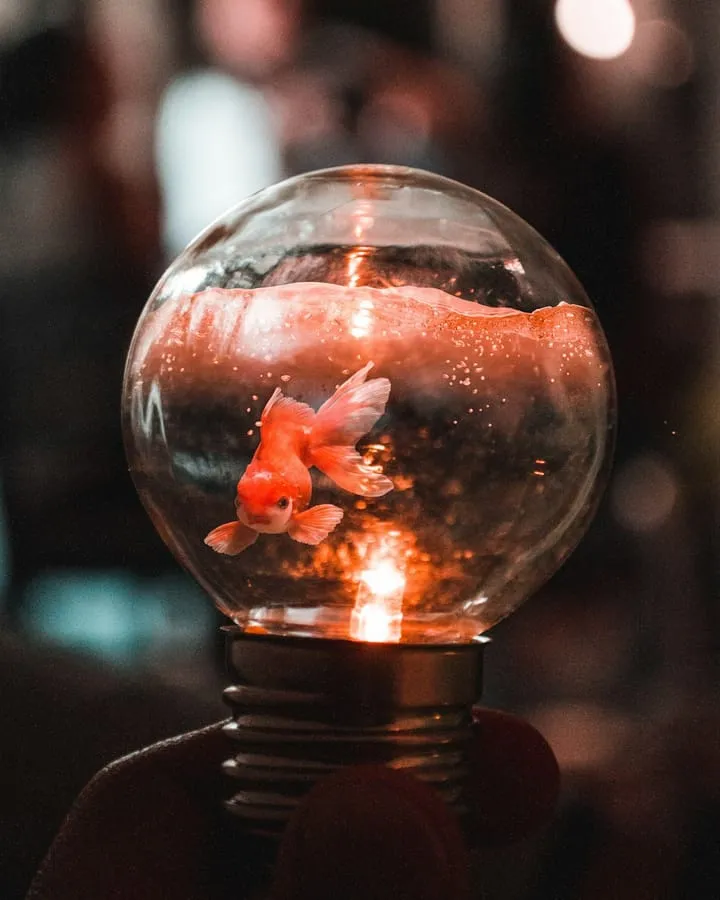
The image of a goldfish in a little bowl is one of the most enduring pictures in pet keeping, and it is thoroughly wrong. Goldfish grow large, are heavy waste producers, and need a big, well-filtered tank to stay healthy, nothing like the tiny unfiltered bowl they are pictured in. That mismatch is why so many goldfish die young or live stunted, unhealthy lives, and it is a failure of the setup, not of the fish. The broader lesson applies to every species: you have to know the adult size and the real needs of a fish, and provide accordingly, rather than trusting the size of the tank it is sold in or beside. A tiny fish in the shop may grow, a single fish may be a schooling species needing a group and the space for it, and a “starter” tank may be nowhere near big enough for the fish sold alongside it.
Getting it right from the start
The practical upshot is a simple principle that prevents a great deal of trouble: choose the tank for the fish, generously, and do it before you buy the livestock.
Research the specific species you want, their adult size, how many you need to keep, whether they shoal, and how much space and filtration that adds up to, and then get a tank that genuinely meets it, erring larger rather than smaller. Set it up and cycle it properly before the fish arrive, as covered in why fish keep dying, and stock it lightly, since a lightly stocked larger tank is the most stable and forgiving of all. This order, tank sized honestly for the fish first, fish second, is the same principle that runs through good fishkeeping generally, and it is the opposite of the impulse buy where the fish is chosen first and squeezed into whatever tank is to hand.
Tank size, in the end, is not a detail to economise on but the foundation the whole tank rests upon. Get it right, err on the side of more water, and match the fish honestly to the space, and you give your fish stable conditions, room to live, and the long, healthy lives they are capable of. Get it wrong, and no amount of care quite makes up for a fish kept in a world that is simply too small.
Common questions
- How big a tank do my fish need?
- It depends entirely on the species, their adult size, how many you keep, and whether they shoal, but the honest answer is usually bigger than the tank they are sold in. Research the specific needs of each fish, and err larger, since bigger tanks are more stable and forgiving as well as better for the fish.
- Can a goldfish live in a bowl?
- No. Goldfish grow large, are messy, and need a big, filtered tank, not a bowl, which cannot provide the space, filtration, or stable water they require. The goldfish bowl is one of the most enduring and harmful myths in fishkeeping, and it is behind countless early goldfish deaths.
- Is a bigger tank easier or harder for a beginner?
- Easier, which surprises people. A larger volume of water is more stable and dilutes waste and mistakes, so conditions change more slowly and forgivingly. Small tanks swing quickly in temperature and chemistry, making them harder, not easier, to keep healthy despite seeming simpler.
- What happens if my tank is too small for the fish?
- Overcrowding and too little space cause poor water quality, stress, stunted growth, aggression, disease, and shortened lives. Many problems that look like bad luck or illness are really symptoms of fish being kept in too small a space, so getting the size right prevents a lot of trouble.