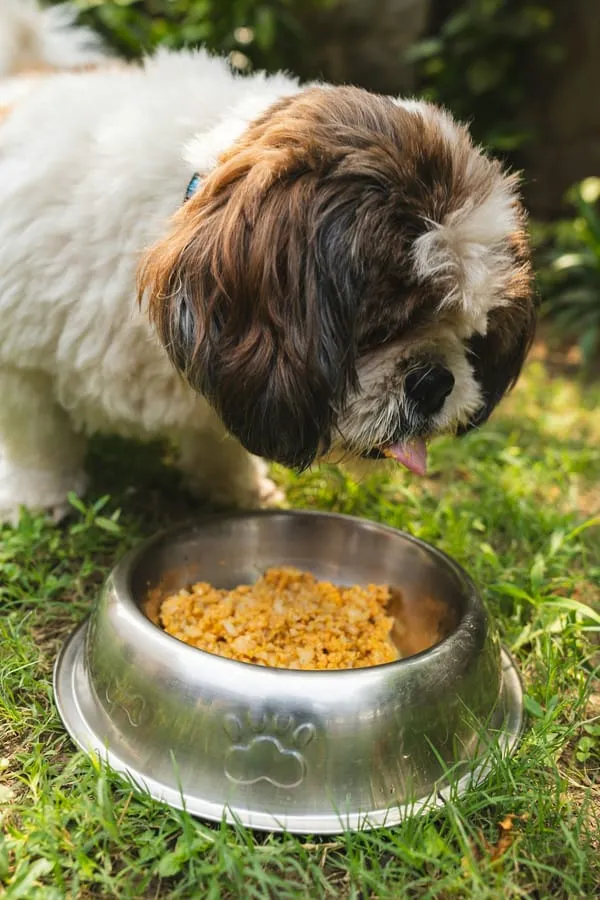
Almost everyone feeds by the bag. You scoop the amount the packet suggests for a dog of that weight, tip it in the bowl, and assume the job is done. Then a year later the vet mentions your dog could stand to lose a bit, and you are genuinely surprised, because you followed the instructions.
The instructions were never that precise. The number on the bag is an average across a lot of very different dogs, and it tends to run generous. The right amount for your dog is something you arrive at by watching the dog, not by trusting the packet. Here is how to do that.
Why the bag can’t know
Two dogs of the same weight can need noticeably different amounts of food. A busy young working-breed dog that runs for two hours a day burns through far more than a steady older dog of the same size who likes a gentle amble and a long sleep. Whether a dog is neutered, their age, their metabolism, even the weather, all move the number.
A feeding guide cannot see any of that. It gives you a band based on weight alone, which is a reasonable place to start and a poor place to stop. So treat the bag as your opening guess, measure it out properly with a scoop or scales rather than eyeballing it, and then let your dog’s body tell you whether the guess was right.
The measure that matters more than weight
The single most useful skill in feeding a dog is the body condition check, and it takes about ten seconds once you know it. It matters more than the number on the scales, because it tells you what that weight is actually made of.
Run your hands over your dog’s ribcage. You should be able to feel the ribs quite easily, with only a thin layer over them, without having to press. Look down at your dog from above: there should be a visible waist, a narrowing behind the ribs, rather than a straight or bulging outline. From the side, the belly should tuck up towards the back legs rather than hanging level. Ribs you can see starkly and hips that stick out mean too thin. Ribs you cannot find, no waist, no tuck, mean too much.
Once you can read body condition, feeding almost looks after itself. Ribs getting harder to feel over a few weeks, cut the portion back a little. Ribs getting sharp, feed a bit more. You are aiming to hold a lean, comfortable shape, and small adjustments over time do that far better than chasing an exact gram count.
The treats problem nobody counts
Here is where most well-fed dogs quietly gain weight. It is not the meals, it is everything around them.
Training treats, a dental chew, the crusts off the toast, a bit of cheese to hide a tablet, the tail-end of your dinner. Individually they feel like nothing. Added together across a day they can be a serious chunk of what your dog eats, and it is all on top of full meals. A good rule is that treats and extras should make up no more than about a tenth of your dog’s daily food, and that anything you give as a treat comes out of the main meals to keep the total steady.
If your dog is on the round side despite sensible meals, the treats are almost always where the maths went wrong. You do not have to stop them. You just have to count them, and to use smaller pieces, because a dog values the fact of a treat far more than its size.
Life stage and the honest caveats
The approach above, start with the guide, adjust to body condition, count the treats, fits most healthy adult dogs on a good complete food. A few situations need more than that.
Puppies are their own subject: they need more food relative to their size, fed in smaller and more frequent meals, and a diet formulated for growth, because getting a growing dog’s nutrition wrong has lasting effects. Pregnant and nursing dogs, very old dogs, and any dog with a health condition such as diabetes, pancreatitis, or a food-responsive problem can have specific needs that override the general advice here. If your dog falls into one of those groups, or you are trying to manage a weight problem that is not shifting, that is a conversation with your vet, who can factor in the whole picture and set an actual target.
For the everyday dog, though, feeding well is less about finding a perfect number and more about paying attention. Measure the meals, run your hands over the ribs every week, keep the treats honest, and adjust gently as you go. A dog kept lean and steady this way tends to be a healthier, longer-lived, more comfortable dog, and it costs you nothing but the habit of looking.
Common questions
- Should I just follow the feeding guide on the dog food bag?
- Use it as a starting point, then adjust. Bag guides are broad averages and usually err high. The real test is your dog's body condition over the following weeks, whether they are holding, gaining, or losing.
- How do I know if my dog is the right weight?
- Learn the body condition check. You should be able to feel the ribs easily without pressing hard, see a waist from above, and see a tuck-up in the belly from the side. If the ribs are hard to find, your dog is carrying too much.
- Do treats really make that much difference?
- They add up fast. Treats and scraps should be no more than about a tenth of your dog's daily food, and a few dropped bits of dinner plus training treats can quietly blow past that. Count them, and take them out of the main meals.
- How often should I feed my dog?
- Most adult dogs do well on two meals a day. Puppies need more frequent, smaller meals. Some dogs with certain health conditions have specific needs, so follow your vet's advice where one applies.