
Almost everyone thinking about getting a dog asks the same first question, how much does the puppy cost, and it is close to the least important number involved. A dog is a ten to fifteen year commitment, and the purchase price, whatever it is, is a one-off at the very start. What actually determines the cost of owning a dog is everything that comes after: the food, the insurance, the vet care, the bits people forget, and the near-certainty of at least one big unexpected bill somewhere along the way. So this is an honest look at the true cost of a dog over its whole life, so you can decide with the real number in view rather than the puppy price.
Costs vary a great deal with your dog’s size and breed, where you live, and the choices you make, so treat everything here as realistic UK estimates to plan around rather than a quote. If anything, it is safer to assume the higher end.
The upfront costs
The start of dog ownership carries two lumps: buying the dog, and setting it up.
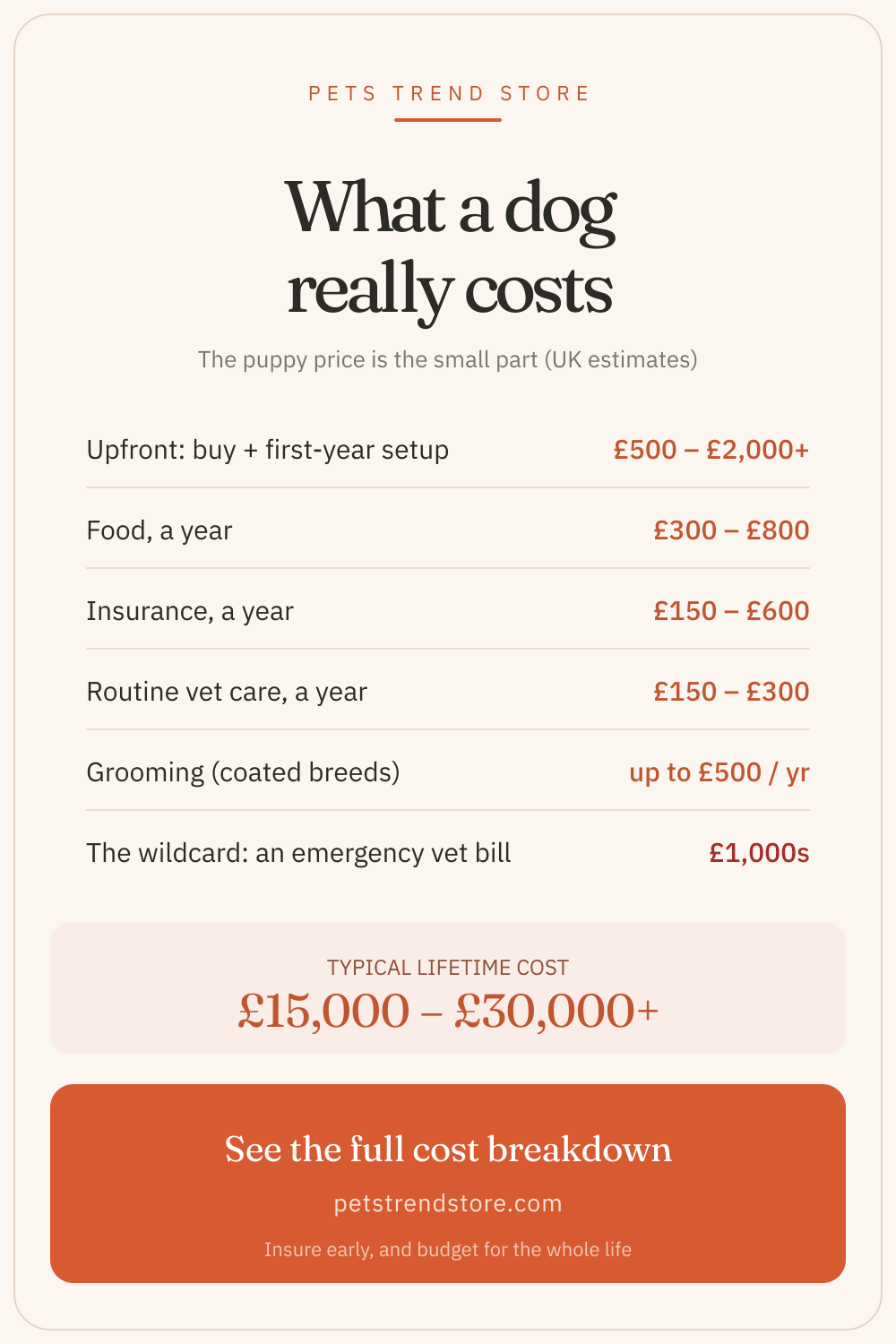
The purchase price varies enormously, from a rescue fee well under a few hundred pounds to a health-tested pedigree puppy running into four figures. On top of that, the first year brings the setup: neutering, initial vaccinations, microchipping, and the kit, a bed, crate, harness, lead, bowls, and toys, sized and made to suit the dog. None of this is the expensive part of dog ownership, but it front-loads a fair chunk of spending into the first few months, and it is worth having ready rather than being surprised by it.
The ongoing costs, year after year
This is the real cost of a dog, the money that goes out every year for its whole life.
The steady annual costs are food, insurance, routine veterinary care such as vaccinations and health checks, and preventive treatments for fleas and worms. For a typical dog these add up to somewhere around £1,000 to £2,000 a year, and more for a large breed with a big appetite or a breed prone to health problems. Size is the single biggest swing factor on the predictable costs: a large dog eats more, needs bigger everything, and often costs more to insure and treat. This is why two dogs can cost wildly different amounts to keep, and why it is worth thinking about size and breed before you fall for a face.
The costs people forget
Beyond the obvious, several real costs catch owners out because they are easy to leave off the mental budget.
Insurance premiums rise as a dog ages, often substantially, so the cheap puppy policy is not what you will pay at ten. Coated breeds need professional grooming every few weeks, which runs to hundreds of pounds a year for the life of the dog. If you work or travel, dog walking or boarding is a recurring cost. Dental care, worn or lost kit, training classes, and the occasional non-emergency vet visit all add up. And then there is the big one.
Keeping the cost sensible
None of this means a dog has to break the bank, and several choices genuinely lower the total.
Buying or rescuing wisely, insuring early and properly, and keeping your dog at a healthy weight all reduce lifetime costs, the last one more than people realise, since an overweight dog is both more expensive to feed and far more likely to develop costly health problems. Feeding the right amount rather than overfeeding, staying on top of cheap preventive care like dental and parasite treatment, and keeping up grooming to avoid bigger problems all pay off. Our dog food calculator helps you feed the right amount, and our guide on telling if your dog is overweight helps you keep the shape right.
Breed by breed
Because so much of the cost depends on the specific dog, it is worth looking at the breed you have in mind rather than an average. We have honest, breed-by-breed cost breakdowns for some of the most popular choices:
- How much does a French Bulldog cost? (the vet bills are the story)
- How much does a Labrador cost? (a big appetite over a long life)
- How much does a Cockapoo cost? (the grooming people forget)
The honest bottom line is that a dog is a significant, multi-year financial commitment as well as an emotional one, and the owners who cope best are the ones who knew that going in. Budget for the whole life, not the puppy, insure properly, and choose a dog whose size and needs fit what you can comfortably afford, and the cost becomes a manageable part of a relationship that is well worth it. If you are still choosing, our guide to choosing the right dog for your life is the place to start. And for the bigger picture, including how much is now paid out in pet insurance claims each year, see our UK pet ownership statistics.
Common questions
- How much does it cost to own a dog per year?
- For most dogs, the ongoing cost runs to somewhere around £1,000 to £2,000 a year once you include food, insurance, routine veterinary care, preventive treatments, and the usual extras, and more for large breeds or dogs with health problems. That is before any one-off emergencies. The exact figure depends heavily on your dog's size, breed, health, and how you choose to insure and care for it.
- What is the biggest cost of owning a dog?
- Over a lifetime, it is usually the combination of food and veterinary care, with unexpected vet bills being the cost that catches people out most. A single emergency or a chronic condition can run to thousands of pounds, which is why insurance, or a dedicated savings buffer, matters so much. The purchase price, by contrast, is a small share of the total.
- What costs do people forget when getting a dog?
- The ones most often overlooked are insurance rising with age, professional grooming for coated breeds, boarding or dog walking when you are away or at work, dental care, and the near-certainty of at least one significant vet bill over the dog's life. Budgeting only for food and the puppy is how people end up caught short.
- Is it cheaper to get an older dog or a rescue?
- Often the upfront cost is much lower, since rescue fees are far below breeder prices and many rescues neuter, vaccinate, and microchip before rehoming. The ongoing costs are the same as for any dog, though, and an older dog may have more health needs. Rescuing can genuinely lower the total cost of ownership, but it does not remove the lifelong running costs.