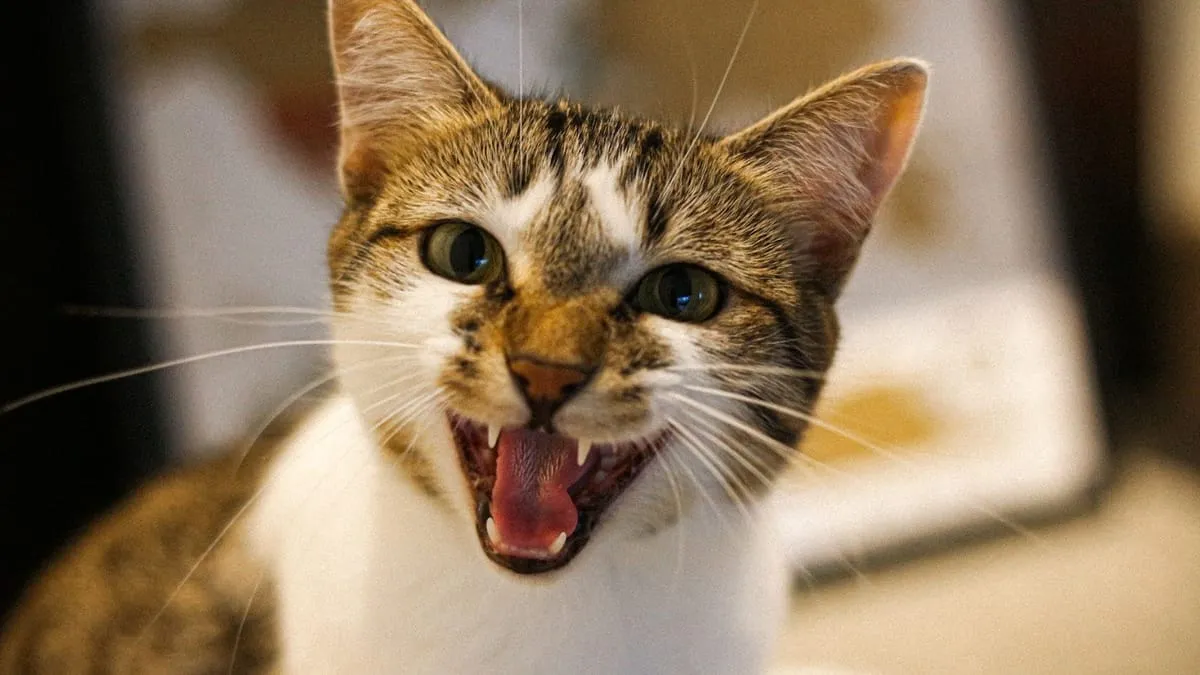
Some cats are simply chatty, and a running commentary is part of their charm. But if your cat is meowing a lot, or noticeably more than it used to, it is worth understanding what all that noise actually means, because a cat’s meow is aimed squarely at you. Interestingly, adult cats rarely meow at each other, they mostly reserve it for humans, having learned that it gets our attention. So a meowing cat is usually telling you something. Here is how to read it, and, importantly, when more meowing is a reason to pick up the phone to your vet rather than just a personality trait.
What your cat is usually asking for
Most everyday meowing comes down to a handful of very ordinary requests.
Cats meow to communicate with us, and the common messages are easy to learn once you watch the context. A cat meowing around mealtimes or by its bowl wants food. One weaving around your legs or leading you somewhere wants attention, or wants you to follow. Meowing at a door means let me in, or out. A chirp or trill as you come home is often a greeting. Some cats also meow more simply because they are bored and want something to happen, or because they have learned that meowing reliably gets a response from you. None of these are problems as such, they are just your cat talking, and answering the genuine needs, while not turning every meow into an instant treat dispenser, keeps the conversation manageable.
When meowing means see the vet
This is the part that matters most, because a change in vocalisation can be an early sign of illness, and it is easy to dismiss as just a phase.
One more common cause worth mentioning is an unspayed female cat in season, which becomes very vocal and restless in a way that is unmistakable once you have seen it, and which neutering resolves along with its other benefits.
The short version is that meowing is your cat talking to you, and most of the time it is asking for the ordinary things, food, attention, access, or company, which you can meet without rewarding every demand. But pay attention to change: a cat that suddenly gets much more vocal, or an older cat that starts calling out at night, may be telling you something is wrong, and that is a conversation to have with your vet. If night-time noise is your particular issue, our guide on why your cat wakes you at night goes into the sleep side in more detail.
Common questions
- Why does my cat meow so much?
- Adult cats mostly meow to communicate with people rather than with other cats, so a talkative cat is usually asking for something, whether food, attention, to be let in or out, or a greeting. Some breeds and individuals are simply chattier than others. The important thing is to notice what your cat wants and whether the meowing is normal for it, since a clear change in how much your cat vocalises is more telling than the raw amount.
- Why is my cat meowing more than usual?
- A noticeable increase is worth paying attention to, because it can signal hunger, stress or a change in the household, boredom, an unspayed cat in season, or a health problem. In older cats especially, more meowing, particularly at night, can be a sign of conditions like an overactive thyroid, high blood pressure, or age-related confusion. A sudden or marked change in vocalisation is a good reason for a vet check.
- Should I ignore my cat's meowing?
- Meet genuine needs first, food, water, a clean litter tray, company, and rule out illness, but try not to reward pure demand-meowing by giving in every single time, or you teach your cat that meowing works like a switch. The balance is to respond to real needs and to attention-seeking on your terms rather than the instant your cat demands it, while never ignoring a sudden change that could be a health issue.
- Why does my old cat meow so much at night?
- Increased night-time meowing in a senior cat is common and often has a medical cause worth investigating, such as an overactive thyroid, high blood pressure, failing senses, or feline cognitive dysfunction, a dementia-like condition. It can be distressing for the cat as well as for you. Rather than treating it as a behaviour quirk, have an older cat that starts howling at night checked by your vet.