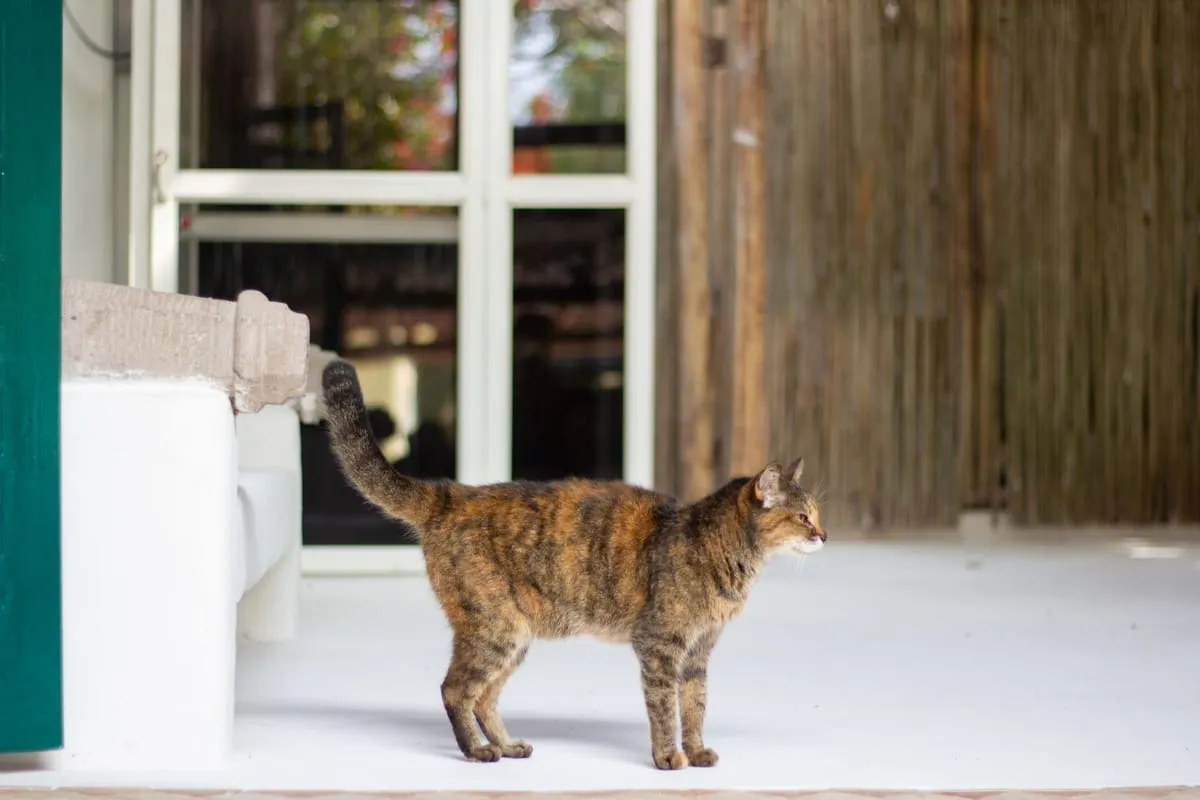
Finding a strong-smelling mark low on a wall or the side of the sofa is one of the more unsettling things a cat can do to a home, and it often gets lumped in with a cat “forgetting” the litter tray. It is not the same problem. Spraying is a cat standing upright, tail raised and quivering, backing a small amount of urine onto a vertical surface to leave a scent behind, and it is communication, not an accident or a bathroom failure. Working out why it is happening matters more than cleaning it up, because the smell will keep coming back until the underlying reason changes.
Spraying versus a litter tray problem
The posture is the giveaway. A cat that is spraying stays standing, tail up and often trembling at the tip, and marks a vertical surface, a wall, a door frame, a curtain, the corner of a cabinet. A cat with a toileting problem squats low and produces a full amount on a horizontal surface, usually the floor near, but not in, the tray.
They come from different places and need different fixes. Toileting outside the tray is almost always about the tray itself, the litter, its location, cleanliness, or a health issue making the tray uncomfortable or hard to reach, and our guide on why your cat won’t use the litter tray covers that side in full, including the urgent case of a male cat straining to urinate. Spraying is about territory and stress, and that is what the rest of this guide deals with.
What actually drives spraying
Territory and stress sit behind almost every case. Cats mark boundaries and reassure themselves with scent, and they lean on it harder when something in their world feels uncertain. A new pet or person moving in, a house move, rearranged furniture, building work, or another cat appearing on the other side of a window are all common triggers, and the marks often cluster near doors, windows, or the specific new object that unsettled things.
Tension between cats sharing a home is one of the biggest drivers in multi-cat households, even when the cats never actually fight. Marking near shared resources, food, the tray, a favourite sleeping spot, is often a sign that the arrangement of the household needs rethinking as much as the individual cat does. Our guide on introducing a new cat is worth reading if the spraying started around the time another cat joined the home.
An unneutered or unspayed cat spraying as part of normal hormonal behaviour is the other major category, and it is worth ruling in or out early since it changes the whole approach.
What genuinely helps
Start by working out the trigger where you can. If another cat outdoors is visible through a particular window, blocking the view with frosted film or keeping blinds closed at the times that cat appears often has more effect than anything else on the list. If the change was a new pet, person, or piece of furniture, giving your cat time and a few safe, familiar spaces while things settle usually reduces marking on its own.
Neutering or spaying, if not already done, resolves spraying in the large majority of cases where hormones are the main driver, and it is worth doing regardless of the current behaviour. For stress and territory-driven spraying, a synthetic pheromone product can genuinely help, a plug-in diffuser for the room where marking happens most, or a spray version for spot-treating a specific door frame or piece of furniture your cat keeps returning to. Neither works overnight, give it several weeks alongside addressing the actual trigger rather than judging it after a few days.
Clean every marked spot properly with an enzyme cleaner made for pet urine, not a household cleaner, since anything that leaves a trace of the original scent behind invites a cat to top the mark back up. In a multi-cat home, make sure resources, trays, food, water, resting spots, are spread through the house rather than clustered in one area, so no cat has to defend or compete for access.
When to get help
A cat that starts spraying suddenly, especially one that has never done it before, is worth a vet visit before anything else, partly to rule out a urinary problem masquerading as marking and partly because a vet can help judge whether hormones, stress, or territory is the more likely driver in your specific home. If spraying continues despite neutering, an identified trigger being addressed, and a few weeks of consistent management, a vet or a qualified cat behaviourist can look at the fuller picture, since persistent spraying is very rarely a behaviour a cat cannot be helped out of, but it sometimes needs a more tailored plan than the general approach here.
Common questions
- What is the difference between spraying and my cat weeing outside the tray?
- Spraying is a small amount of urine backed onto a vertical surface, a wall, a door frame, the side of furniture, usually with the tail held up and quivering while the cat stays standing. It is a scent-marking behaviour, not a toileting one. A cat squatting to pass a full amount on the floor is a different problem, usually pointing to the litter tray itself or a health issue, and it needs a different approach.
- Why has my cat suddenly started spraying indoors?
- A sudden start almost always means something in the cat's world has changed or feels unsettled, a new pet or person in the home, another cat visible through a window, moved furniture, or tension with a cat they already share the house with. An unneutered or unspayed cat is also far more likely to spray as a normal part of hormonal behaviour. Because spraying and a painful urinary problem can look similar from a distance, a sudden change is still worth a quick vet check to rule out the medical route first.
- Does neutering stop a cat from spraying?
- It resolves it in the large majority of cases, especially when done before a cat reaches sexual maturity, since spraying is closely tied to hormonal scent-marking and territorial behaviour. It is not a guaranteed fix for a cat that is already an established sprayer or one whose spraying is being driven mainly by stress rather than hormones, but it removes the biggest single driver and is worth doing regardless of the current behaviour.
- Will Feliway actually stop my cat spraying?
- For stress and territory-driven spraying, a synthetic pheromone product genuinely helps a meaningful number of cats, though it works gradually over several weeks rather than overnight and works best alongside removing or reducing whatever is unsettling the cat, not instead of it. It is not a fix for spraying driven mainly by an intact cat's hormones, or for an underlying medical problem, so it is one part of the approach rather than the whole thing.