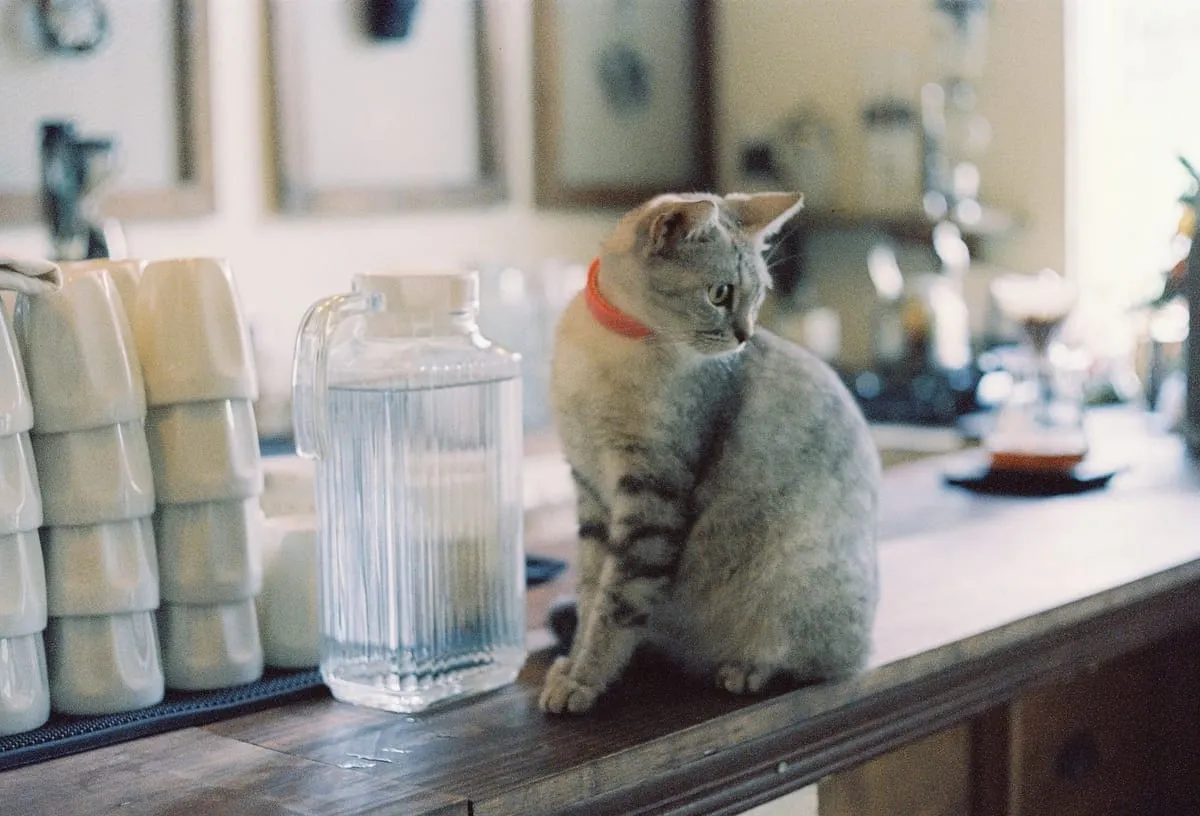
Lifting a cat off the counter for the tenth time in a day, saying “no” in your firmest voice, and watching it jump straight back up the second you turn around is one of the most common frustrations cat owners bring up. It can feel like your cat is simply ignoring you. It is not. The counter is giving your cat something it genuinely wants, and until that changes, telling it off will keep losing.
What the counter actually offers a cat
Height is the biggest draw, and it is not optional for a cat, it is closer to a need. Cats are built to survey their space from above, and a kitchen counter is often the tallest, most open surface in the house. From up there a cat can watch the room, keep an eye on the door, and stay out of reach of anything on the floor, all things a cat is wired to want.
Food is the other obvious pull, crumbs, a forgotten plate, the smell of whatever you just cooked. Even a cat that is never deliberately fed from the counter learns quickly that good things sometimes turn up there. Warmth plays a smaller role too, a sunny patch near a window or the residual heat from the stove is worth investigating on its own.
Why telling your cat off does not fix it
Cats do not connect a delayed consequence with the action that caused it the way dogs sometimes can. By the time you have crossed the kitchen and lifted your cat down, several seconds have usually passed, and your cat is far more likely to associate your approach, or you generally, with something unpleasant than to link it back to being on the counter.
This is also why a spray bottle or a stern voice tends to produce a cat that is warier of you specifically, sometimes jumpier and more prone to hiding, without actually reducing the climbing. Behaviourists have moved away from recommending it for exactly this reason. The counter still offers the same reward the moment you are out of the room, so the behaviour keeps happening, just more secretively.
What actually works
The most reliable fix has two parts: give your cat somewhere else that offers the same thing, and make the counter itself less rewarding, rather than relying on catching your cat in the act.
Give height somewhere else. A tall cat tree or a window perch placed near where your cat already likes to watch the room gives it a legitimate version of exactly what the counter offers. Cats that have satisfying vertical space of their own are noticeably less driven to find it on a surface you do not want them using.
Take away the food incentive. Wipe counters down properly, do not leave plates or scraps out, and store food where a cat cannot smell or reach it. If the counter stops paying out, it stops being worth the climb quite as often.
Make the surface itself unpleasant, consistently. This is the part owners usually skip, and it is the part that actually breaks the habit fastest. A motion-activated deterrent like an automatic spray canister fires the moment your cat gets close, so the counter does the correcting even when nobody is home to catch it. Double-sided sticky tape along the edge works on the same principle for a cat that dislikes the feel of it on its paws, and Sticky Paws is a cheap way to try it without covering the whole surface permanently.
Give it time
Most cats settle into a new pattern within a couple of weeks of a consistent approach, not overnight. Expect some testing early on, especially if the counter has worked reliably for a long time before you changed anything. A cat that keeps trying is not failing to learn, it is checking whether the old rules still apply, and holding the new setup steady is what actually gets the message across.
If your cat’s climbing has changed suddenly, especially an older cat that has never shown much interest in counters before, it is worth a quick think about whether something else is going on, since a jump in food-seeking behaviour can sometimes point to appetite or health changes rather than a habit. Our guide on signs your cat is in pain covers some of the subtler changes worth watching for alongside it.
Common questions
- Why does my cat keep jumping on the counter even after I tell it no?
- Because "no" does not explain what to do instead, and the counter still offers everything that made it appealing in the first place, height, a good view, and sometimes food. Cats also do not connect a scolding that comes seconds after the jump with the jump itself, so shouting mostly teaches a cat to avoid you, not the counter, especially once you have left the room.
- Is it OK to spray my cat with water to stop it jumping on counters?
- Most trainers and behaviourists now advise against it. A water spray usually teaches a cat to be wary of you rather than to avoid the counter, and it can damage trust without solving the actual behaviour, since the cat is just as likely to jump up the moment you are out of sight. A deterrent that works on the counter itself, rather than one that comes from you, tends to hold up far better.
- What is the best deterrent to keep cats off counters?
- Motion-activated spray deterrents and double-sided sticky tape are the two most reliable options, because both make the counter itself unpleasant rather than relying on you catching the moment. Aluminium foil or an upside-down plastic mat can work as a cheap first try, though most cats get used to it faster than they do a spray or tape.
- Will a cat tree actually stop counter surfing?
- On its own, not entirely, but it removes one of the main reasons cats climb in the first place, the drive for height and a vantage point. Pair a tall cat tree or window perch with keeping food and scraps off the counter and a genuine deterrent on the surface itself, and most cats redirect their climbing to the spot you actually want them using.