Free tool
Dog age calculator
Convert your dog's age into human years the accurate way, adjusted for size, not the old 'multiply by seven' myth. See roughly how old your dog really is and what life stage that means.

The "seven dog years" myth
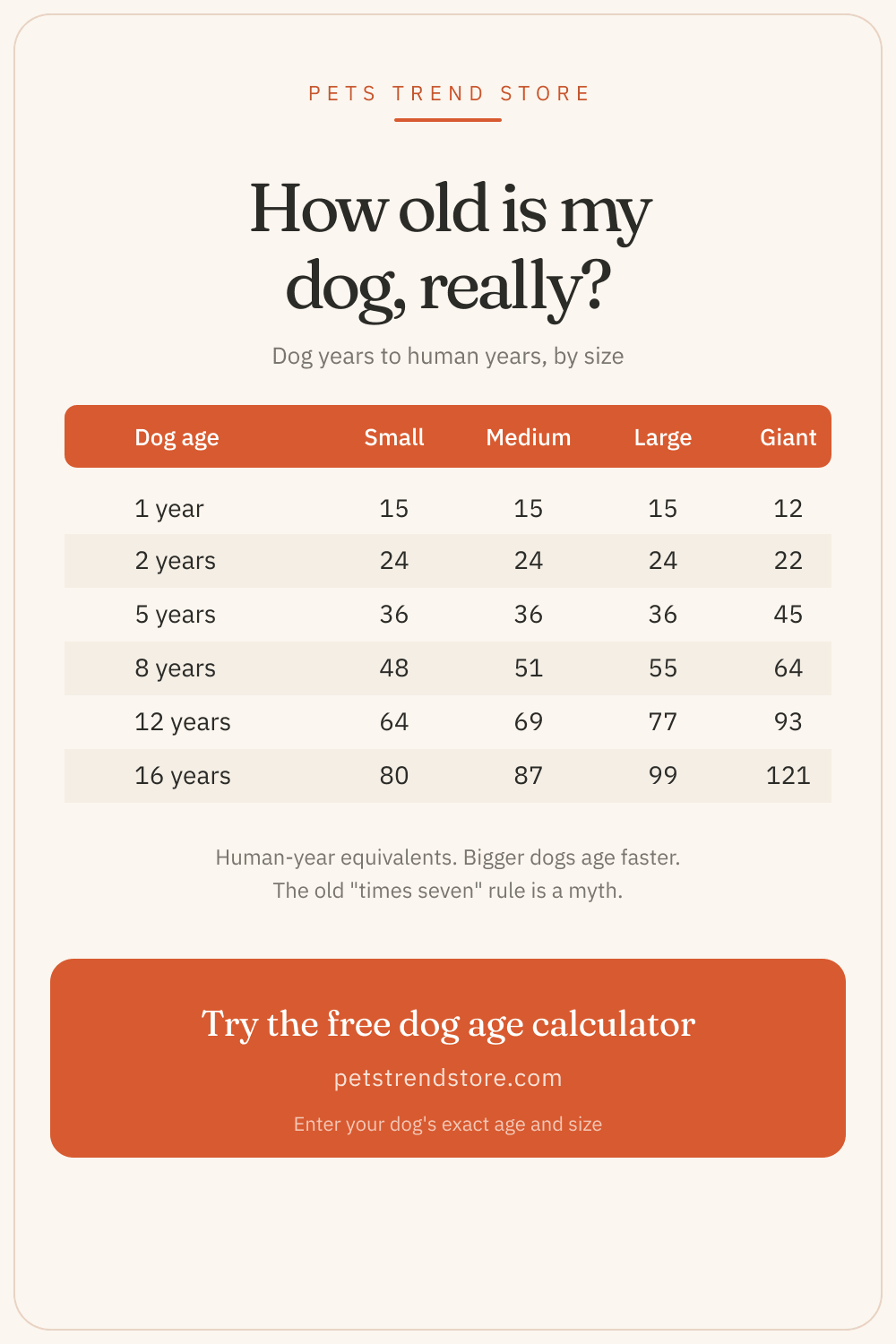
The old rule that one dog year equals seven human years is one of the most repeated pieces of pet folklore, and it is simply wrong. Dogs do not age at a steady rate. They grow up very fast in their first couple of years, reaching the equivalent of a teenager by their first birthday, and then age more slowly. Multiplying by seven gets almost every age wrong, and it ignores the big factor the calculator above uses: size.
How dogs really age
A more accurate picture, and the one used by vets and kennel clubs, goes roughly like this. A dog's first year is worth about 15 human years, and the second adds about another nine, so a two-year-old dog is loosely comparable to a person in their mid-twenties. After that, each dog year adds somewhere between about four and seven human years, and this is where size matters: small dogs age more gently and live longer, while large and giant breeds age faster and reach old age sooner. That is why a great dane of seven is well into its senior years while a small terrier of seven is barely middle-aged.
What the life stages mean
Knowing your dog's rough human age is not just a bit of fun, it is a useful prompt for care. As a dog moves from adult into its mature and senior years, it becomes more prone to things like joint stiffness, dental disease, and weight changes, and its needs shift. Senior dogs benefit from more frequent vet check-ups, ideally twice a year, so age-related problems are caught early, along with attention to weight, comfort, and any changes in behaviour. When exactly a dog counts as senior depends on its size, earlier for big dogs, later for small ones, which the calculator reflects.
Common questions
Is one dog year really seven human years?
No, that is a myth. Dogs age much faster in their first two years, roughly 15 human years in year one and about nine more in year two, and then more slowly, at a rate that also depends on their size. Small dogs tend to live longer and age more gently later in life, while giant breeds age faster. The 'times seven' rule is a rough average that is wrong at almost every age.
How do I calculate my dog's age in human years?
Use your dog's real age and its size. Count the first year as about 15 human years and the second as about nine more, then add roughly four to seven human years for each year after that, more for larger dogs. This calculator does that for you using the size-based approach vets and kennel clubs generally use.
Why does a dog's size change how it ages?
Larger and giant breeds mature and age faster and have shorter lifespans, so a large dog of eight is 'older', in human terms, than a small dog of the same age. Smaller dogs generally live longer and are considered senior later. That is why a good age estimate takes size into account rather than using one number for every dog.
When is a dog considered a senior?
It depends on size. Small dogs are often not considered senior until around ten to twelve, medium dogs around eight to ten, large dogs around seven to eight, and giant breeds as early as six. Senior dogs benefit from more frequent vet check-ups to catch age-related problems early.
This calculator gives a general estimate based on age and size. Real ageing varies between individual dogs and breeds, so treat the result as a helpful guide rather than an exact figure, and speak to your vet about your dog's specific health and life stage.