People often ask me how to train a cat to stop scratching, and the honest reframing is that you cannot, and you should not want to. Scratching is not a behaviour problem to be eliminated. It is a deep, healthy need, and a cat with no outlet for it is a cat under quiet strain. What you can absolutely do is decide where it happens, and move it off your sofa and onto something built for the job. That is the whole game: not stopping, redirecting.
Why cats have to scratch
To fix this, it helps to understand what your cat is actually getting out of dragging its claws down the armchair, because it is doing several things at once.
It is maintaining its claws, shedding the worn outer sheath to keep them healthy. It is stretching, pulling the whole length of the body and working the muscles, which is why a good scratch so often comes with a long luxurious reach. And it is marking territory, both visibly with the scratch marks and invisibly through scent glands in the paws. That last part is the key to the furniture problem. Cats deliberately scratch in prominent, socially important places, which to a cat means the sofa in the middle of the living room, not a post tucked away in the spare bedroom.
Once you see scratching as a need with a purpose rather than an act of vandalism, the solution stops being “how do I punish this” and becomes “how do I give a better option than the one they have chosen”.
The post is probably the problem
When a cat ignores its scratching post in favour of the furniture, the post is almost always at fault in one of a few predictable ways.
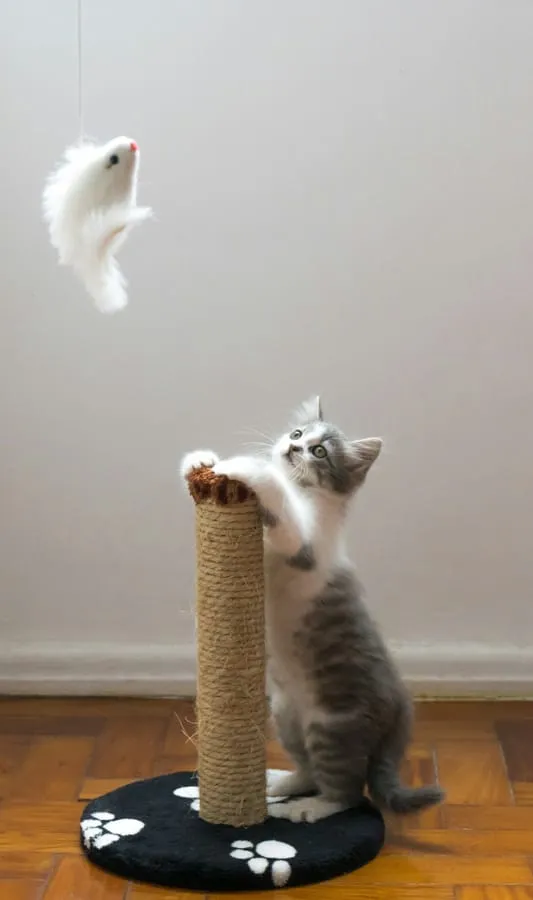
Height is the big one. A cat wants to scratch at a full stretch, so the post has to be tall enough for it to reach up and really pull, taller than the cat standing on its back legs. Many shop-bought posts are far too short, and a cat cannot get the stretch it wants from them. Stability is next: if the post wobbles or tips when leaned on, a cat will abandon it, because scratching needs something solid to work against. And the surface matters. Most cats strongly prefer coarse sisal rope or bare wood over carpet, and something they can shred a little.
If the furniture is winning, take it as feedback that the furniture is currently a better scratching surface than anything you have provided, and fix that before anything else.
Put the right post in the right place
Location undoes more good posts than any other single thing. People buy a decent post and then hide it somewhere out of the way to keep it from spoiling the room, which is precisely where the cat does not want it.
Put the post where the cat already scratches. If the target is the corner of the sofa, the new post goes right next to that corner, not across the room. Cats scratch in prominent places on purpose, so a post in a prominent place is what competes. Once the cat is reliably using it, you can inch it a little further away over weeks if you must, but start at the scene of the crime.
It also helps to have more than one, especially in a bigger home or a multi-cat house, so there is always an acceptable surface near where the urge strikes. A cat is not going to trek across the house to a post when the sofa is right there.
Make the post win, and protect the sofa meanwhile
Now make the right choice the rewarding one. Draw the cat to the post with play, trailing a toy up and over it so the claws catch. Rub or sprinkle it with catnip if your cat responds to it. And the moment your cat scratches the post, even by accident, make it pay: warm praise, a treat, a bit of fuss. You are teaching the cat that this surface produces good things.
At the same time, quietly make the furniture less appealing while the habit shifts. You can cover a favourite spot temporarily with something cats dislike scratching, such as a smooth throw or double-sided tape on the target area, so the sofa stops rewarding the behaviour while the post takes over. This is management, not the fix, so pair it with the good post rather than relying on it alone.
Give it a couple of weeks of making the post tall, stable, well-placed, and rewarding while gently protecting the furniture, and most cats move across of their own accord. You have not trained the scratching out of your cat, which was never possible, you have simply given it somewhere better to do what it was always going to do. If you want to help a bored indoor cat put that energy somewhere useful more generally, the ideas for keeping an indoor cat busy work hand in hand with this.
Common questions
- Why does my cat scratch the furniture and not the post I bought?
- Usually the post is wrong for the cat, too short, too wobbly, or in a spot the cat does not care about. Cats scratch to stretch and mark in prominent places, so a sturdy, tall post right where they already scratch beats a flimsy one hidden in the corner.
- Is it cruel to stop a cat scratching?
- Stopping scratching altogether would be, because it is a natural need. Redirecting it to an acceptable surface is not cruel at all. The goal is to give the cat a better place to do it, not to prevent the behaviour.
- Should I declaw my cat to stop it scratching?
- No. Declawing is the amputation of the last bone of each toe, it is banned in many countries, and it causes lasting pain and behaviour problems. It is never an appropriate answer to furniture scratching.
- How do I get my cat to use a new scratching post?
- Place it where the cat already scratches, make it tall and stable, and make it rewarding, rub it with catnip, praise and treat any use, and play around it. Do not carry the cat over and force its paws onto it, which tends to put cats off.